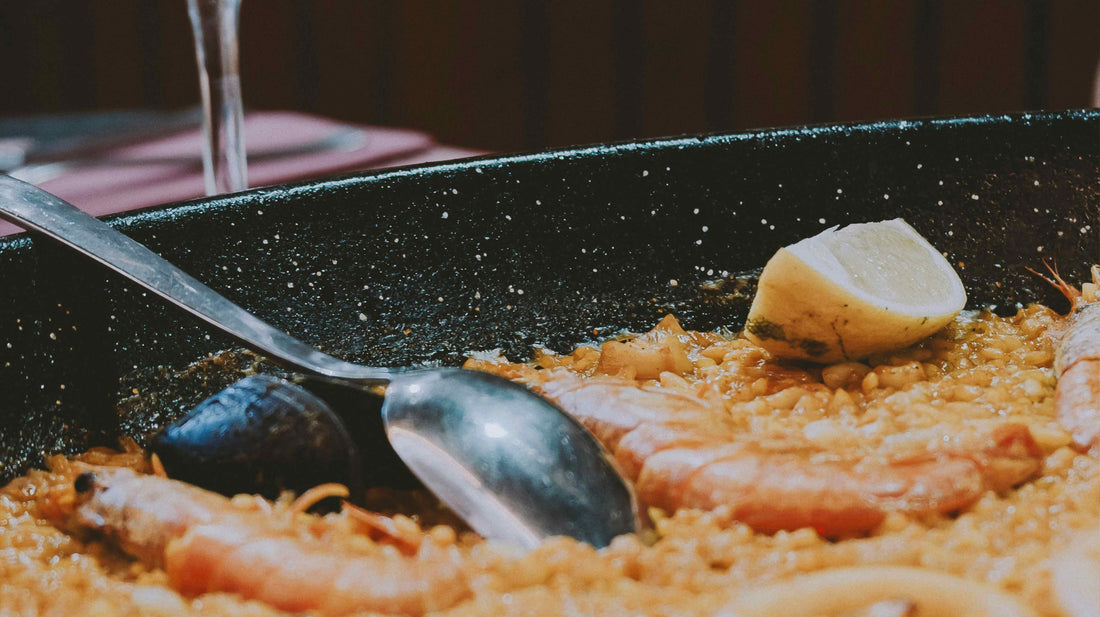
Eating paella: a custom with more history than protocol
Few scenes capture the spirit of cooking as well as a freshly made paella, placed in the center of the table, surrounded by several diners. No plates, no rush, no pretense. Just the rice, the fire, and the desire to share. But is it proper to eat directly from the paella pan ? Is it impolite or a centuries-old tradition?
In this article we will debunk myths, rescue truths and, above all, understand why, when done with respect, this practice can be one of the most authentic gestures of Valencian cuisine.
Eating from paella: bad manners or tradition?
One of the most widespread myths is that eating from paella is bad manners. However, in the origins of this dish, when farmers or fishermen prepared rice outdoors, they ate the paella with a wooden spoon, each from their own "square" of the paella pan.
The key isn't whether you eat paella , but how you do it. There are unwritten rules: don't encroach on someone else's portion, don't stir the rice or mix different areas, and respect the center until everyone has had a turn. This way of eating is social, egalitarian, and practical, and allows you to enjoy the rice at its perfect temperature and texture.
What if we talk about hygiene?
One of the most common arguments against eating directly from the paella pan is hygiene. But it's worth clarifying. In a meal among family, close friends, or trusted individuals, actual contact is minimal if the unwritten rules that have accompanied this tradition for generations are followed.
Each diner eats from their own designated area, without encroaching on the next person's, using their own spoon. No one scrapes the entire pan or mixes the contents, and certainly no one stirs the rice. In fact, in the past, many opted for wooden spoons, not only for convenience but also out of respect for the pan: this prevented scratching the bottom of the paella or disturbing the socarrat ( the crispy bottom layer of rice). This kind of gesture demonstrates a level of care and respect for the dish that is rarely found in other ways of eating.
Of course, for more formal meals or with close friends and family, such as at public events or professional gatherings, it makes sense to serve individual portions. Etiquette evolves depending on the context.
In fact, we could say that eating paella is also a gesture of emotional closeness . Like sharing bread at the same table or toasting with the same wine: it's a way of breaking down barriers, of feeling part of something shared. And like any well-understood tradition, it has its own rules, its own sense of order, and a beauty that cannot be explained unless it has been experienced.
So it's not about a lack of hygiene, but about understanding the context and respecting the custom. Because if there's anything that unites people more than rice, it's the act of sharing it as it's always been done: with trust, with care... and with your own spoon.
A ritual with roots: the history of shared paella
In the early days of paella, there were no white tablecloths or designer dishes. Paella was a country dish, born among farm laborers, farmers, and fishermen, who cooked outdoors over wood fires or vine cuttings. The paella pan was placed in the center, and each diner ate directly from their side, using a wooden spoon.
This gesture wasn't a breach of etiquette: it was a show of camaraderie, equality, and practicality. People ate in quadrants, respecting each other's space, without crossing paths, without stirring. The center, where the socarrat forms, was left for last. And it was shared like a small, common reward.
The expression " fer la paella " refers not only to cooking the dish, but also to the social gathering that surrounds it: getting together, talking, waiting for the fire to heat up, toasting... and, yes, eating together from the same pan. It's part of the cultural DNA of the Valencian Community.
Unwritten rules for doing it right
As with any tradition, there are implicit rules:
- Each person eats from their "quadrant" or section
- The rice is not stirred
- Do not invade the other person's space.
- You start at the edge and move towards the center
- The socarrat , in the middle, is left to be shared at the end
This respect for individual space turns the meal into a silent choreography of spoon and rice, where everyone shares the same plate without losing courtesy.
Modern myths vs. real customs
Over time, with the globalization of gastronomy, the custom of eating paella has been interpreted (and misinterpreted) in many ways. Some people believe it's unhygienic, unappealing, or "homey." But in reality, it all depends on the context and respect for tradition.
Thus, as we mentioned before, in informal or family gatherings, eating directly from the paella is still a gesture of closeness and trust, while in more formal contexts, such as restaurants or protocol celebrations, it is served in individual dishes.
Is eating paella for everyone?
Of course, not everyone is comfortable with this practice, and that's perfectly fine. The important thing is to understand that it's not a written rule, but a custom. If the occasion allows, eating directly from the paella pan can become a gastronomic ritual of intimacy and authenticity.
Of course, you need a good paella pan, a burner that distributes heat evenly, like the one SIDONNIS makes, and well-cooked rice.
Technique and fire: without a perfect paella, no ritual is worthwhile
For this tradition to be meaningful, the rice must be up to par . And for that, the heat is everything. If you cook with an uneven flame, in a warped pan, or with poorly distributed heat, the rice will stick together, remain hard around the edges, and be overcooked in the center.
That's where the SIDONNIS gas burner comes in, with its instant ignition, two adjustable rings, and stable power. A good fire doesn't just cook: it transforms paella into a truly shared experience.
Thanks to the precision you can achieve with this burner , the rice reaches its perfect consistency, the broth is absorbed just right, and the socarrat appears exactly where it should. Eating paella is only worthwhile if the result is worthy of it. And that can only be achieved with technique, experience, quality ingredients, and a well-controlled fire.
Eating directly from the paella pan is not a whim, a fad, or a breach of etiquette. It's a way of being together, of savoring the shared effort, and of honoring a culture that understands that fire not only cooks, but unites.
So, the next time you cook paella, consider putting the plates aside and reviving the traditional gesture of eating with respect, with a spoon, and with great enjoyment.